
Gum disease is one of the most common chronic conditions in adults, yet most people don’t catch it until it has already done real damage. That gap between early signs and late diagnosis is where the trouble lives. The gums rarely hurt in the early stages, which is precisely why so many people dismiss the first signals as minor irritations. Understanding what those signals actually mean — and why they escalate the way they do — is the difference between a cleaning appointment and a surgical procedure.
The Early Signals Most People Explain Away

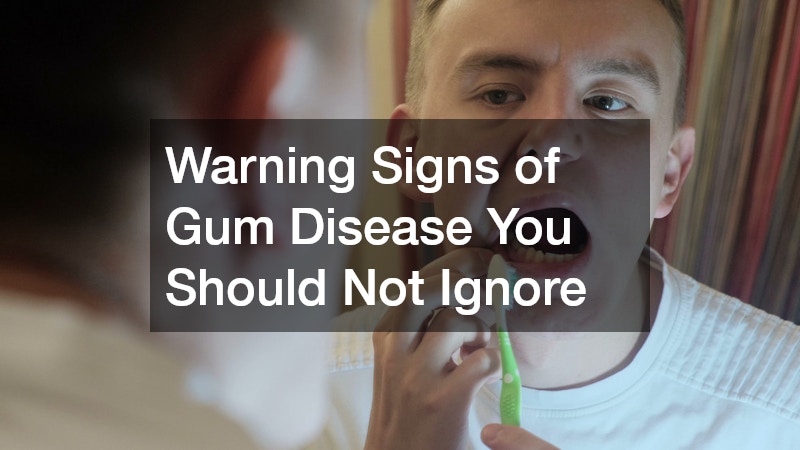
Bleeding gums during brushing are almost universally dismissed as a flossing problem, a hard toothbrush problem, or a brushing-too-vigorously problem. Occasionally, those explanations are correct. But consistent bleeding — meaning it happens most days, not just after an aggressive session — is the textbook early marker of gingivitis, the reversible first stage of gum disease. Healthy gum tissue simply does not bleed from normal brushing contact.
Alongside bleeding, watch for persistent puffiness or a reddish, dark pink color along the gum line. Healthy gums are firm and pale pink, almost coral-toned. When bacterial plaque accumulates at the gum margin and is not removed consistently, the immune system triggers inflammation in the surrounding tissue. That inflammation is gingivitis — and it can be fully reversed with improved hygiene at this stage.
The critical point is timing. Gingivitis becomes periodontitis when the infection moves below the gum line. At that point, the bone and connective tissue anchoring the teeth begin to break down. That damage is not reversible.
Signs That Suggest the Disease Has Progressed
Once gum disease advances past gingivitis into periodontitis, the warning signs become harder to rationalize. Gum recession is one of the clearest indicators. When the gums pull back from the teeth — making teeth appear longer or exposing the yellowish root surfaces — it often reflects bone loss underneath. Some recession can result from aggressive brushing, but recession paired with other symptoms on this list warrants serious attention.
Persistent bad breath that does not resolve with brushing is another sign worth taking seriously. The bacteria involved in periodontal disease produce volatile sulfur compounds as a byproduct of their activity. These compounds have a distinct, unpleasant odor that mouthwash temporarily masks but cannot eliminate, because the source is bacterial colonies living in deepening pockets between the gum and tooth root.
Pocket depth is something a dentist measures during a periodontal probing exam. Healthy pockets typically measure 1 to 3 millimeters. Readings between 4 and 6 millimeters suggest early to moderate periodontitis. Pockets of 7 millimeters or more indicate advanced disease. Most patients have no idea these pockets exist because they cause little to no pain.
Tooth sensitivity to temperature — specifically new or worsening sensitivity that tracks with any of the symptoms above — can indicate recession exposing root surfaces that lack the enamel protection found on the crown.
When Teeth Feel Loose or Change Position
Tooth mobility in an adult is a symptom that warrants immediate evaluation, not a wait-and-see approach. As periodontal bone loss progresses, the foundation supporting the teeth weakens. Teeth may shift slightly when pressed with the tongue or when biting, and in advanced cases they may visibly drift from their original positions. This shifting can also change the way the upper and lower teeth meet — a bite change that comes on without orthodontic treatment is a red flag.
Between managing early-stage gum disease with improved home care versus treating established periodontitis, the differences in both commitment and cost are substantial. Early gingivitis typically responds to professional cleaning and rigorous at-home brushing and flossing — a realistic, low-cost intervention. Moderate periodontitis often requires scaling and root planing, a deep cleaning procedure that can run $200 to $400 per quadrant depending on practice location and case complexity. Advanced cases may require surgical intervention, bone grafting, or in the worst scenarios, extraction and replacement. The financial gap between catching the disease early and treating it late is measured in thousands of dollars.
Risk Factors That Amplify the Warning Signs
Certain conditions make gum disease progress faster and make early warning signs easier to dismiss because they seem attributable to something else.
Smoking is the most significant behavioral risk factor. Tobacco use constricts blood flow in the gums, which means smokers experience less bleeding even as the disease advances — one of the reasons smokers are often diagnosed at more severe stages than non-smokers. The absence of bleeding does not equal gum health.
Diabetes creates a two-way relationship with gum disease: poorly controlled blood sugar accelerates periodontal infection, and periodontal inflammation in turn makes blood sugar harder to regulate. People managing diabetes should treat any gum symptoms as a priority rather than a secondary concern.
Hormonal changes during pregnancy can trigger pregnancy gingivitis — intensified gum inflammation in response to elevated hormone levels — even in women with previously healthy gums. This is not a reason to avoid dental care during pregnancy; it is a reason to be more vigilant about it.
Certain medications, including anticonvulsants, calcium channel blockers, and some immunosuppressants, can cause gum overgrowth, which changes how the gum tissue looks and can make it harder to identify early signs of infection.
What Professional Screening Actually Catches

Routine dental exams are specifically designed to detect gum disease before patients notice symptoms. A full periodontal charting, typically completed at least once annually, records pocket depths, bleeding on probing, recession levels, and tooth mobility across all teeth. Dental X-rays detect bone loss that is not visible to the naked eye.
The limitation of self-monitoring is straightforward: the inside of a periodontal pocket is inaccessible without instruments. Patients feel pain reliably in tooth decay because decay often reaches the pulp. Gum disease can destroy bone without generating the pain signals that drive people to schedule an appointment. Your local dentist can identify active disease in areas that feel entirely normal, which is precisely why skipping routine exams tends to convert manageable conditions into complex ones.
Acting on the Signs Before the Window Closes
Recognizing these warning signs matters only if recognition leads to action. If gums bleed consistently during brushing, if teeth feel loose, if bad breath persists despite thorough cleaning, or if the gum line looks visibly lower than it once did, schedule a periodontal evaluation — not a standard cleaning, but an exam that specifically includes probing and radiographic assessment if not recently completed.
The trajectory of gum disease is well understood: early intervention interrupts it, late intervention manages it, and no intervention eventually means tooth loss. Most adults lose teeth to periodontal disease, not decay. That proportion shifts significantly for those who treat the early signals as the information they actually are.